
Data Science & AI Engineering
From mathematical foundations and predictive machine learning to deep learning, LLMs, AI agents, and production MLOps.
4–6 Months
3 Months Practical
Verified Projects
5 Core Modules
Engineered for High Technical Competence
Data Science & AI Engineering bridges the critical gap between classical data science and modern AI software engineering. Learners master exploratory analytics, statistical modeling, machine learning, deep learning with PyTorch, and generative AI engineering—all backed by production-grade MLOps pipelines.
What You Will Master
- Master exploratory data analysis, statistics, and hypothesis testing with Python, Pandas, and NumPy
- Build, evaluate, and interpret supervised and unsupervised ML models with Scikit-learn and XGBoost
- Develop deep neural networks for vision and NLP using PyTorch and Transformer architectures
- Engineer advanced Generative AI applications with LLM APIs, LangChain/LlamaIndex, and Vector Databases
- Implement autonomous AI agents using function calling and Model Context Protocol (MCP)
- Package, deploy, and monitor scalable AI services using FastAPI, Docker, MLflow, and Cloud Platforms
Detailed Course Syllabus
All topics and modules are extracted directly from the official course specification.
5 Detailed Syllabus Modules
Tools & Technologies Taught
Directly aligned with production engineering environments.
Capstone Projects
Five comprehensive hands-on milestone projects culminating in an end-to-end production AI engineering application.
Data Science Project
Sprint ProjectEnd-to-end exploratory data analysis, hypothesis testing, and business impact modeling on complex real-world data.
Machine Learning Project
Sprint ProjectPredictive model training, hyperparameter tuning, explainability, and containerized API deployment.
Deep Learning Project
Sprint ProjectComputer vision or NLP application built using PyTorch and Transformer architectures.
GenAI Project
Sprint ProjectRetrieval-Augmented Generation (RAG) assistant leveraging semantic search and vector stores.
Production AI Engineering Capstone
Sprint ProjectFull production-ready AI application featuring LLM integration, agentic tool-use, FastAPI backend, Docker deployment, and MLflow monitoring.
3-Month Practical Internship
Structured internship focusing on real-world predictive modeling, deep learning architectures, and production AI application deployment.
Internship Highlights
- Structured engineering sprint cadence
- Peer code reviews and architecture defense
- Portfolio deployment to production cloud instances
Verified Course Learning Outcomes
Course Specific Questions
What background is recommended before enrolling?
Basic mathematics and fundamental programming exposure are recommended. Foundations in Python, statistics, and data structures are covered thoroughly in Module 1.
How does this course differ from a traditional Data Science program?
Unlike traditional programs that stop at Jupyter notebooks, this program integrates AI Engineering, Generative AI (LLMs, RAG, Agents), and MLOps deployment into production systems.
What projects will I build for my portfolio?
You will build 5 milestone projects including an end-to-end data science study, an ML predictive API, a PyTorch deep learning system, a RAG assistant, and a production-grade multi-tier AI application.
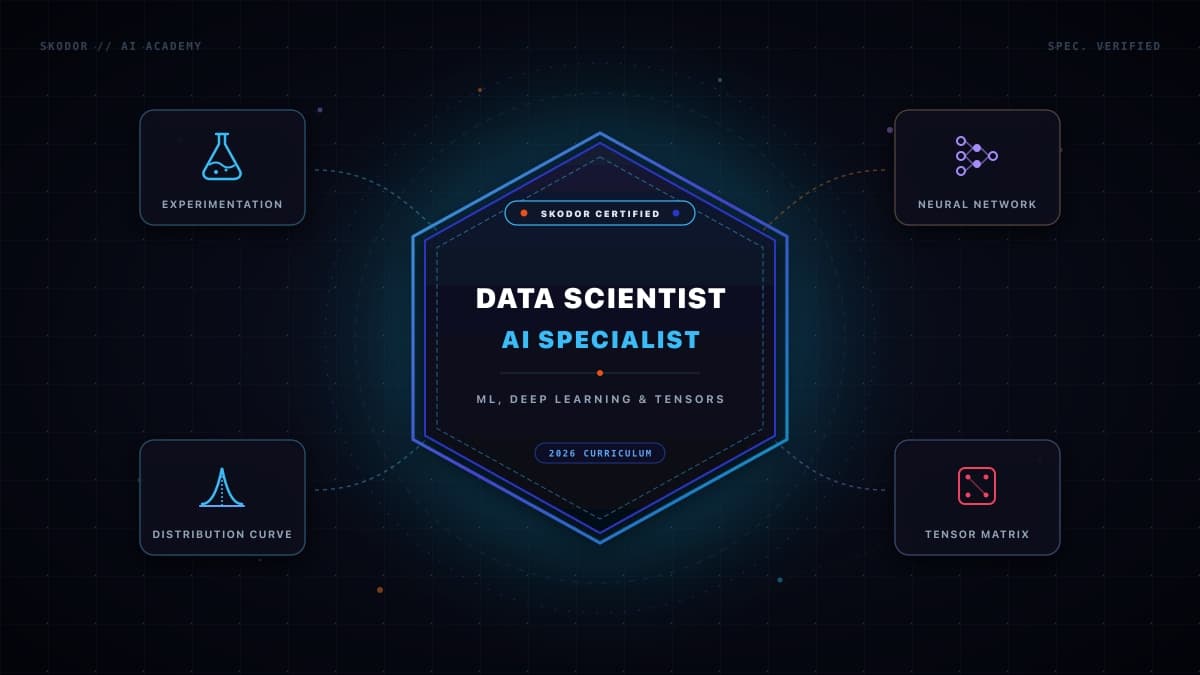
Earn Your Data Science & AI Engineering Certification
Every successful graduate receives an industry-recognized certificate demonstrating verifiable competence in real-world systems, architectures, and practical engineering execution.

Proof of Practical Engineering Autonomy
Unlike traditional course certificates awarded for passive video watching, SKODOR credentials prove that you built, debugged, and shipped commercial-grade systems.
Verifiable Credential
Includes unique cryptographic credential ID and instant QR code verification for recruiters and hiring managers.
Demonstrated Production Skills
Issued only upon completing all technical modules, code reviews, and defending live capstone deliverables.
Shareable Globally
Seamlessly add your verified SKODOR certificate to LinkedIn, personal engineering portfolios, and resumes.
Verified with immutable credential ID • Globally shareable on LinkedIn
Enroll in Data Science & AI Engineering
Cohorts have limited seating to maintain high mentor-to-student interaction and rigorous code reviews. Speak with an admissions advisor today.